
the hand and wrist bones indicate Lucy was a knuckle-walker
Lucy’s Feet
Specimen
A. afarensis
Recovery
Hadar, Ethiopia
Original Find
1974 · Johannsen
Skeleton
~40% complete
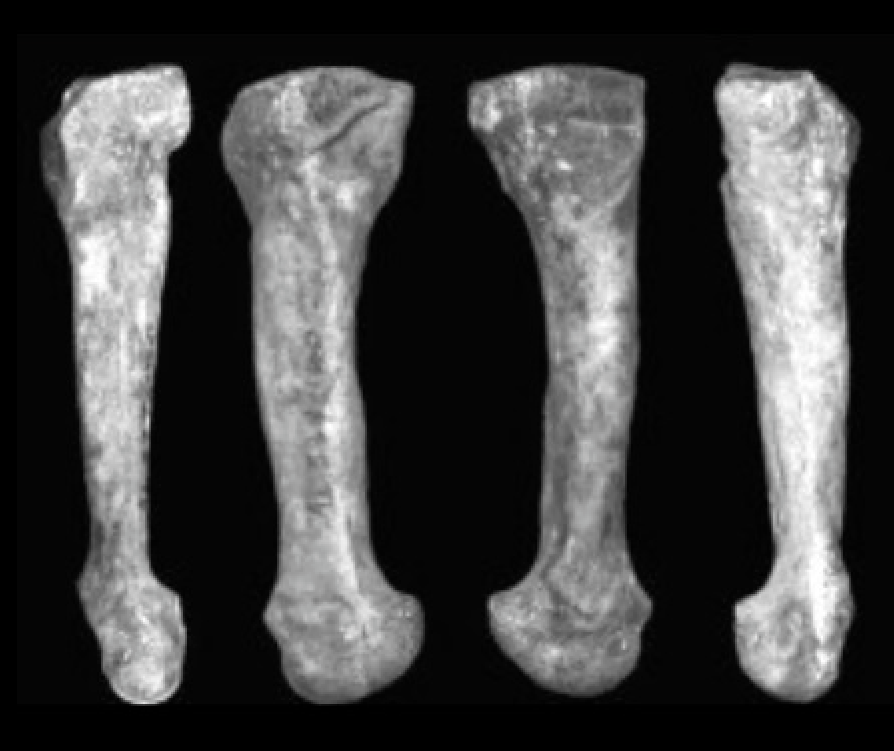
The Find
Lucy is in the news again with the discovery of a single metatarsal in Ethiopia where all the Australopithecus afarensis "Lucy" fossils have been found. One of the photos shows four views of the bone found. The next photo of a skeletal foot then shows where the researchers place the bone--in a HUMAN foot--of course that is very speculative on their part.
Two Sites
Site A
Hadar
Ethiopia · Lucy fossils
Site B
Laetoli
Tanzania · Laetoli prints
Part of the excitement surrounding this new discovery is due to the fact that no foot bones had ever been found for Lucy until now (note the photo of the famous original find by Donald Johannsen--a 40% complete skeleton without any foot bones). However, having no bones did not deter many evolutionists from claiming that Lucy had humanlike feet. On what basis you may ask? Their claim is based on fossil footprints found ~1000 miles away in Tanzania--the famous Laetoli prints. These footprints would be considered human (and are by creationists) by any "uninformed" observer, however, since evolutionists date the Laetoli prints to be 3.6 million years old, they de facto refuse to assign them to Man. Coincidentally, though the Lucy fossils found in 1974 by Johannsen were originally determined to be close to 2 million years old, based on radiometric measurements, the determined age was changed to the 3+ million year range of the Laetoli prints found 4 years later. Then Lucy was credited with making those prints with her humanlike feet!
Originally
~2million years old
Then revised to
3+million years old
A Telling Quote · National Geographic, March 1996
I wanted to get a human soul into this apelike face to indicate something about where she was headed.
An artist for the March 1996 National Geographic
Three Anatomical Objections
This is consistent with many interpretations of the evidence concerning Lucy which are driven more by the motivation to present Lucy as an "apeman" than a pursuit of truth. Another example of this motivation is found in the statement by an artist for a March 1996 National Geographic article depicting Lucy, "I wanted to get a human soul into this apelike face to indicate something about where she was headed."
Creationists' objections to many of the evolutionary interpretations of Lucy fossils, and in particular the 1974 Johannsen discovery, are clearly explained in an excellent video, "Lucy-She's No Lady" by Dr. David Menton. He was assoc. prof. of anatomy in the Washington U. Medical School for 34 years, and now works with Answers In Genesis. Among the issues Dr. Menton explains are,
the "bowlegged" anatomy is not unique to humans; apes which are accomplished at walking along tree limbs also have that anatomical feature
the pelvis, until it was altered by Dr. Lovejoy, was a typical apelike pelvis which would not allow a humanlike in-line stride
All these factors support the interpretation that Lucy was an ape not very different from several apes alive today.
Have a question for Dr. Scripture?
Ben answers reader questions in this column. Reach out by email and your question may be featured next.